Gilles de Rais was a Breton baron, marshal of France, and possibly one of the most interesting murderers in history. His fascination for Satanism and murder led him to commit atrocious acts that would remain in history as some of the vilest murders. Officially, Gilles de Rais is known to have murdered 150 children, but there are some authors who report a much bigger number of about 800 children.
 Gilles de Rais was born in 1404 and he was also known for being a brave soldier and fighting beside Joan of Arc. He was a very ambitious man who became one of the richest men in France, with power only few managed to have.
Early Life
From a very early age Gilles de Rais was considered to be extremely ambitious and he grew up with his grandfather after his father died in Machecoul, near the border of Brittany. His first two marriage attempts ended up with the brides being killed, which makes some authors link him to Bluebeard. However, he managed to marry the wealthy Catherine de Thouars of Brittany, after kidnaping her.
Military Career
Life in Retirement
The Murders
 Most victims were unaccompanied children in the countryside or nearby villages that were taken to the castle, treated like royalty and killed in the end. Murder was actually a blessing for victims since most were tortured. He later described how he “inflicted various types and manners of torment; sometimes they severed the head from the body with dirks, daggers, and knives, sometimes they struck them violently on the head with a cudgel or other blunt instruments, sometimes they suspended them with cords from a peg or small hook in his room and strangled them; and when they were languishing he committed the sodomitic vice on them”. Sexual encounter occurred before or after death and it seemed that he preferred boys; however, when they weren't available, girls were the victims, but he still preferred sodomy in their case. It seems that Gilles De Rais also kept his favorite victims' limbs and heads after the murders and kissed them. He was absolutely fascinated with the act of death and watched closely how his victims died, often masturbating in the process. Some confessions show even more gruesome images, as he described how he loved the elastic warmth of the victims’ intestines. He also liked to rip their hearts through wounds that he slowly enlarged and he had a preference for children with blonde hair and blue eyes with ages between 6 to 18.
 In The Encyclopedia of Occultism and Parapsychology there is a story on how his wife discovered his murders:
("Gilles de Rais (1404-1440)." Encyclopedia of Occultism and Parapsychology. 2001. Retrieved November 11, 2012 from Encyclopedia.com: http://www.encyclopedia.com/doc/1G2-3403801926.html )
Madame de Rais communicated her fears and anxieties to her sister. The two women wondered what went on in the castle. Why was her lord so gloomy? What signified his repeated absences? What became of the children who disappeared day by day? What were those nocturnal lights in the walled-up tower? These and other questions caused both women to burn with curiosity. But what could they do?
The marshal had expressly forbidden them even to approach the tower, and before leaving he had repeated this injunction. It must surely have a secret entrance, Madame de Rais and her sister Anne agreed, and they proceeded to search through the lower rooms of the castle, corner by corner, stone after stone. At last, in the chapel, behind the altar, they came upon a copper button hidden in a mass of sculpture. It yielded under pressure, a stone slid back, and the trembling curiosity seekers distinguished the lowermost steps of a staircase, which led them to the condemned tower.
At the top of the first flight there was a kind of chapel, with an inverted cross and black candles; on the altar stood a hideous figure, no doubt representing the devil. On the second floor they came upon furnaces, retorts, alembics, charcoal—all the apparatuses of alchemy. The third flight led to a dark chamber where the heavy and fetid atmosphere compelled the young women to retreat. Madame de Rais bumped into a vase, which fell over. She then became aware that her robe and feet were soaked by some thick liquid. On returning to the light at the head of the stairs, she found that she was bathed in blood. Anne would have fled from the place, but Madame de Rais's curiosity was stronger than her disgust and fear. She descended the stairs, took a lamp from the infernal chapel, and returned to the third floor, where a frightful spectacle awaited her. Copper vessels filled with blood lined the whole length of the walls, bearing labels with a date on each. In the middle of the room was a black marble table on which lay the body of a child, obviously murdered recently. It was one of the gory basins that had fallen, and black blood spread over the grimy and worm-eaten wooden floor.
The two women were horrified. Madame de Rais endeavored at all costs to destroy the evidence of her indiscretion. She used a sponge and water to wash the boards, but she only extended the stain, and that which at first seemed black became all scarlet.[...]
Terrible rumors spread through all the countryside. Many young girls and boys had disappeared; some had been traced to the castle of Champtocé and not beyond. The public accused de Rais of murder and of crimes even worse than murder. It was true that no one dared openly accuse a baron so powerful as the lord of Rais. Whenever the disappearance of so many children was mentioned in his presence, he reacted with the greatest astonishment. Suspicions aroused are not easily allayed, however, and the castle of Champtocéand its lord had acquired a fearful reputation and were shrouded in mystery.
The continued disappearance of young boys and girls had caused so bitter a feeling in the neighborhood that the church felt compelled to intervene. At the urging of the bishop of Nantes, the duke of Brittany ordered de Rais and his accomplices arrested.
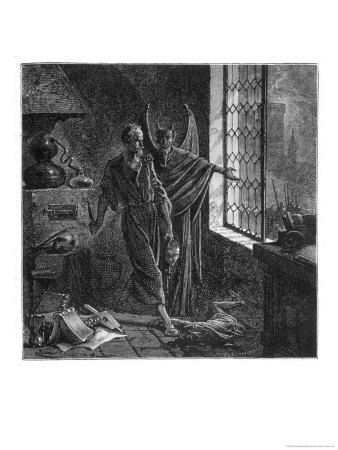
This went for a few years with many children being kidnapped, tortured and killed. Unfortunately, his wealth started to fade and he turned once again to Satanism, hoping to improve his condition. However, this didn't work, even though he was sending the devil human sacrifices.
The Arrest, Trial, and Execution
 The first error that he did was to kidnap a clergyman after a dispute with him. He was arrested with all his servants in September 1440 and brought to trial in Nantes. He refused to plead to the charges but eventually he declared himself not guilty. Eventually he admitted to have murdered the children, under torture or not. Gilles testified that “when the said children were dead, he kissed them and those who had the most handsome limbs and heads he held up to admire them, and had their bodies cruelly cut open and took delight at the sight of their inner organs; and very often when the children were dying he sat on their stomachs and took pleasure in seeing them die and laughed” He was condemned for heresy and sentenced to execution by hanging and burning for murder. As requested, he was the first to die and his body was cut down before being completely burn.
 Some authors argue that he was merely a victim of the Inquisition in that time and he may have been tortured to testify for the gruesome acts. Whether that is true, we don’t know; what we do know is that he insulted Geoffroi de Ferron in 1440, the powerful treasurer of the neighboring province in Brittany by having his brother beaten and imprisoned. Because of that, he was summoned and trialed, and later the murder accusations were brought upon him.
Further reading and resources:
http://www.trutv.com/library/crime/serial_killers/predators/rais/inquisition_12.html
http://absintheliteraryreview.com/archives/fierce9.htm
http://www.britannica.com/EBchecked/topic/489979/Gilles-de-Rais
http://www.nndb.com/people/281/000112942/
http://www.hellhorror.com/killers/serial_killer/55/Gilles-de-Rais.html