Friday, June 3, 2011

Sati - real love or forced suicide?

Sati is a Hindu funeral practice in some Indian communities referring to a widow that immolates herself on her husband’s funeral pyre.

Although the practice was banned in 1829 there were women who still committed Sati either forced by their family or voluntarily.

Origins

The word “sati” means virtuous woman and in Indian tradition a woman who commits sati will be seen as a Goddess and will go directly to heaven. The term also comes from the goddess Sati, also known as Dakshayani who immolated herself because of her father. In the 10th century widows had to commit sati because otherwise they were seen as bad people. It was also believed that committing sati was a way to erase their husband’s sins, so refusing to do it was not in the benefit of their dead husband. However, sati was not popular in all Hindu societies as many of them saw this practice as suicide.

Those in favor of sati say that it is a practice approved by the ancient texts. For example, in Rig Veda Samhita there is a passage called Sati hymn which states:

“Let these women, whose husbands are worthy and are living, enter the house
with ghee (applied) as corrylium (to their eyes).  Let these wives first step into
the pyre, tearless without any affliction and well adorned.”

A woman who committed sati thought that she would follow her husband in heaven. Such a woman will be highly respected, sati stones would be raised in her name called Maha-sati stones, and she would be worshiped by people.  

Sati – voluntary or forced?

Before answering this question we should first explain how a widow was(and sometimes still is) perceived in Hindu societies. They were stigmatized by wearing a white sari, shaving their head, wearing the tika sign on their forehead, eating a single meal, and live an austere life.  The family perceived them as a burden and abandoned or simply rejected them (and some still do this nowadays) so they were forced to live in groups called ashrams.

In these humiliating conditions sati might have been a better option. However, in some cases women were forced by family or simply drugged and pushed into the fire.  Even if it is voluntary, sati is still seen as a collective murder. 

Voluntary sati was documented by Pietro Della Valle  in the town of Ikkeri:

“There was a musical band in front of the procession. The widow was mounted on a horse. She was holding a lemon in her right hand and a mirror in her left. She was constantly making sure her bridal make-up was in tact. An umbrella was held to protect her from the sun. The widow was not in mourning at all. And instead looked as if she was anxious to join her husband. The people in the procession sang her glories and admired her sacrifice. While the system of Sati is a cruel one, the courage of the women is admirable. I am going to visit her on the day of the Sati and pay my respects to her eternal love."

A case of modern sati was that of Roop Kanwar, an 18 year old girl married only for 8 months. Some say she was forced to commit sati by her family while others state that she asked her brother to light the pyre when she was ready. 

 Here you can read about a case of forced sati where a woman is murdered because her family wants her property.  

Wednesday, June 1, 2011

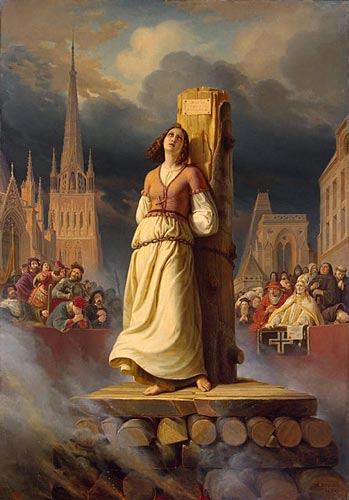
Famous execution methods: Burning at stake

Source

Burning at the stake was a capital punishment method mostly used in the Middle Ages. This type of execution was usually preceded by a long torture(with different devices and instruments) and was a common way to punish blasphemers, thieves and witches, but it was also practiced for adultery and murder. Those who were in favor of burning at stake believed that it was a good way to scare and keep people from committing crimes.

There was, however, a law that required strangulating the person before burning them at stake, but there were many cases when victims were deliberately slowly burned alive. Approximately 200,000 people were burned at the stake for witchcraft because people believed that such an act would cleanse the soul of the condemned heretic; however, it was also a punishment since it meant that those condemned lost the body they would have taken into the afterlife.


A stake was erected for the victim on a spot designed for the following execution and around the stake piles of straw and wood were placed. The victim had their clothes removed and dressed in a shirt imbibed in sulphur; then the executioner would bound them to the stakes. After this, the fire was lit and the victim burned to death.
There were different ways of burning at the stake: the first method used a heap of faggots piled around a wooden stake (it seems that British and Spanish Inquisition had a special preference for this method because of its visual impact). Unfortunately for the victim, this was an extremely agonizing death because they were alive for a long time before the fire reached the head. The second method was more “humane” as it led to a quicker death since the victim died from carbon monoxide poisoning before suffering extreme pain. The third method involved a ladder with the victim tied on it, which was let down onto the fire.

Source
Skillful Cruelty

There were different methods that were known to shorten the sufferings of the condemned person: the executioner placed a large iron bar that would have pushed against the victims and killed them faster or he placed gunpowder in the wood or at the victim’s neck to be sure of a quick death. However, the most fortunate were strangled to death before being burned.  

Other executioners were ordered to prolong their victim’s suffering and they managed to do this by making the fire burn progressively(with green wood) from the calves to the face. There were records of victims that agonized over 2 hours before death.  Some were simultaneously strangled and burned while others were only burned after being hanged for some time.

Here is a presentation of Catherine Hayes’ execution:

When they had finished their devotions (prayers), the carts were moved from under them leaving them suspended. Catherine was of course able to watch the men die and this must have been especially painful for her emotionally as Billings was her son. Attention now turned to her execution. She was taken from the hurdle and secured to a stake, set in the ground a few yards from the gallows, by an iron chain around her body. A cord was put round her neck and passed through a hole bored in the stake, for the purpose of strangling her, in accordance with the normal practice of the time. Two cartloads of faggots (bundles of dry brushwood) were piled around her and at the signal the fire was lit. She begged Arnet to strangle her before the fire reached her and he took the end of the cord and began to pull on it, but the flames blew in his direction burning his hands so he had to let go. She reportedly gave three dreadful shrieks before she was engulfed by the fierce fire and fell silent. She was seen trying to push away the burning faggots with her free hands but to no avail. Contemporary reports claimed that Arnet, seeing her plight, threw a large piece of wood at her head which "broke her skull, when her brains came plentifully out." In any event, she would have suffered terrible burns and shock and been in great pain for some time, before the fire and/or lack of oxygen created by it, overcame her. It was over an hour before her body was reduced to ashes.

Many people believe that burning at stake was only associated with witchcraft; however, it was associated with many other felonies and not all countries resorted to burning at stake for witchcraft. For example in England witchcraft was punished by hanging.  

Famous people burned at stake: Giordano Bruno,  Thomas Cranmer, Joan of Arc, Girolamo Savonarola, and Patrick Hamilton.

Nowadays bride burning  is a form of domestic violence practiced in India.
The Progressive Women's Association  declared that bride burning every year accounts for the violent death of at least 300 women, perpetrated most often by the victims' husbands or husbands' families," said the association's Shamoon Hashmi.