Showing posts with label creepy. Show all posts

Thursday, June 20, 2013

Haunted Places: III Waverly Hills Sanatorium


I decided to continue the series of places that are considered haunted but my reasons for this are not to promote the spread of any paranormal thinking, but because I find it fascinating how people enjoy such activities and how this belief is formed in the collective mind. I will not analyze that here, but I will present another interesting "case" of a building considered haunted.

Waverly Hills Sanatorium didn’t start off as a creepy, death filled building, but as a lovingly made family home for Major Thomas H. Hays’ family who bought the land on which the Sanatorium is
WAVERLY HILLS SANATORIUM
situated in 1883.

Things changed quickly when The Board of Tuberculosis purchased the home as they needed more space due to the Tuberculosis epidemic that was tearing through Louisville in the first years of the 20th century.

With antibiotics not being invented yet, tuberculosis was a big deal, and when the epidemic hit its peak people would die just about every day at Waverly Hills. The seemingly continuous flow of bodies out of the Sanatorium put a damp on the patient’s spirits and didn’t do much to help the survival rate. So to avoid the uncomfortable sight, doctors decided to use a cart in the 500 feet long tunnel to wheel them out. The tunnel has supposedly seen close to 100,000 dead bodies during its lifetime thus earning it nicknames like “the death tunnel” or “body chute”.

Visitors of the abandoned Sanatorium say that weird noises and sometimes screams and moans can be heard within its walls. 

To make things even creepier the legends say that a young nurse hanged herself with a functioning light bulb wire after finding out she was pregnant out of wedlock with the owner’s child and had contracted tuberculosis. It’s said that she can still be seen sometimes in room 502, where she committed suicide. 

As antibiotics led to a quick fall in Tuberculosis cases, the Waverly Hills Sanatorium was sold and transformed into a geriatric center that cared to old sufferers of dementia. The center didn’t last long, as reports of improper care and sometimes out right neglect quickly condemned it. 

If suicide, tuberculosis sick ghosts, and dementia ridden old people aren’t creepy enough for you, please add that  recent owners wanted to convert the building into a prison while other wanted to build a 150 feet tall statue of Jesus. Both ideas fell through for lack of finances.

Current owners are holding haunted tours of the old Sanatorium trying to restore the building with the profits, however, I don’t know if new windows and fresh paint can cover demented tuberculosis zombie ghost death screams, still…  good luck with that!

Sources and More:
https://www.prairieghosts.com/waverly_tb.html

Sunday, June 24, 2012

Ghost Marriage - Death Won't Do Us Part


Ghost marriage is the name of a Chinese tradition where the wedding is performed for two dead people or a dead person and their alive spouse.

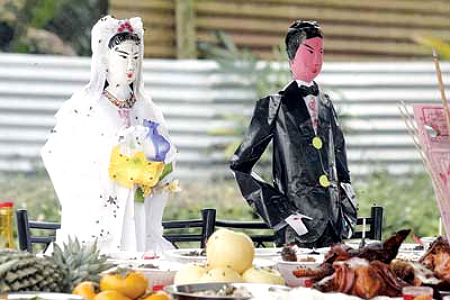
Figurines that symbolize the dead groom and bride in China
The same tradition is practiced in Sudan, India and even France, for various reasons. There are still reports of it being practiced today in Asia and some Romanian communities (in Transylvania, as far as the article author knows). According to the Romanian folklore, a person has to go through three important stages in life: birth, marriage and death. If a person dies without having undergone a marriage ritual, they are married posthumously with another unmarried person. According to anthropologists who study Asian culture, the destiny of a man and a woman is incomplete if they don't marry, perhaps influenced by Confucianism, where the idea complete family appears.

In Chinese tradition the marriage is performed when one or both parties are dead and it’s called “minghun”, meaning spirit marriage. This used to be a common tradition in the past but it’s still done nowadays.

If a bride’s fiancé died before the marriage, she had to option to marry him and move in with his family. She also had to vow to remain loyal to him. The reason behind this practice is probably the fact that there was a sort of social pressure when it came to marrying in the Chinese culture. If the bride chose to go through with the marriage despite her husband being dead, he was represented by a white cockerel at the ceremony. After the marriage was performed she was allowed to adopt a son to continue the lineage of her husband.

Ghost marriages were also performed for two dead soon-to-be married couples. It seems that the relatives took it upon themselves to carry out their wishes. This was also done to create a social bond between two families, a common practice in Asian tradition. Other reasons for ghost marriage were: integrating an unmarried daughter into a patrilineage so that the family line was continued or to maintain that no younger brother was married before an elder brother.

Overview On Social Reasons Behind Ghost Marriage

An unmarried woman has no descendants to worship her or care for her as a part of a lineage and since in every household an altar is displayed with spirits tablets of the paternal ancestors, the married woman’s tablet is kept at the altar of her husband’s family. But if a woman dies unmarried, her family is not allowed to place her tablet on the altar of her natal home and she will be given a temporary paper tablet near the door. This is why ghost marriage seemed to be a viable solution for parents who wanted to see their daughters married so that they had an affiliation to a male descent line. Another fact that is significant when it comes to the stigma unmarried women had to bear is the prohibition of unmarried women to die in their natal home. The tradition involved taking the woman to a shed, an empty house or an outlying building so that she could die. As we can see, unmarried women were a great embarrassment for the family and they still are in Chinese society. Often, they weren’t even allowed to live at home with their families.

The Ghost Marriage Ceremony In Asia and Romania

Ghost marriages are supposed to be set up after the deceased spirit’s request. There are many typical marriage rituals that are performed during the ceremony: the wedding feast, the whole arrangement that is used during weddings (paper effigies of products that would be used in the future married couple’s home like a dressing table, a table with six stools, a money safe, a refrigerator, etc.) When one of the partners is alive, they usually get dressed in the typical ceremonial outfit and the ghost groom or bride is treated as they were alive (being fed at the wedding, people are announced of their arrival, etc.).

Romanian Bride waiting to be wed with a dead unmarried man
According to anthropologist H. Stahl the death of a person who hasn’t been married is very dangerous in Romanian tradition as they haven’t fulfilled the most important aspect of their life. In Romania, the dead person that is about to be buried is dressed for wedding – the bride is dressed in white and she even has bridesmaids dressed according to the event. However, the interesting fact is that the “wedding” participants are not dressed as they would be for a wedding, but dressed for a funeral, which adds to the dramatic image. There’s even a color bearer that is held during the wedding, which is composed of colorful scarves; however, during a posthumous wedding, the color bearer contains black scarves. So, this wedding performed for the dead is in contrast with a normal wedding through different symbols and metaphors that are used in songs. However, the whole tradition is seen differently in Romania than Asia. Women who choose to marry a dead man are allowed to marry again and the families don’t bond. Because the marriage hasn’t been consumed, they don’t have to vow celibacy. If the person who died had a girlfriend, she has to take the role to be his posthumous bride.

Sources and further reading: